When we think of learning “centers”, we often think of a kindergarten classroom with big tables, tons of crayons/glue/scissors, and total commotion. If you are a middle school teacher, think again. Using social studies center activities can be done easily, and without a ton of stress or mess! More importantly, centers can make your content come to life. Keep reading to see how!

Why Social Studies Center Activities in Middle School?
Teaching heavy content to middle schoolers is never an easy task. We, as teachers, are expected to engage our students with content that is often, on the surface, unrelatable. When I was in middle school (or junior high, as it was called back then), the history teachers would basically lecture, tell you to read the textbook, and then give you a test. It’s no wonder so many of our students think history is boring! Creating the right kinds of centers can bring history to students’ level. You can engage your students and have them enjoy your class.
What Comes First?
I have been teaching for a long time, and I have heard more educational philosophies than I care to admit. Some were absurd to me (“whole language”, anyone?!), but a few were “keepers”. One such “keeper” was the “Five E Model”…engage, explore, explain, elaborate, and evaluate. I truly believe that if we follow this model, students will connect. This might seem easier for a “hands-on” subject like science, but with a little creativity, you can do this, and do this well, in social studies.
If you look at where “explain” falls, you will see it does NOT come first. That means, quite simply, don’t start a unit with a lecture or a reading. Do something to really engage your students first. Then, explore. For a social studies class, this could be as simple as playing some related music to a new unit of study (Dave Matthews’ “Don’t Drink the Water”) to engage, and then finding lines of the song to illustrate to explore. Then, you do your explaining, which is your direct instruction.
Time to Elaborate!
For me, the elaboration is the “money maker” of the social studies classroom. This is where you can use centers to really bring your content to life. Honestly, the ways to do this and the ideas are endless…which sometimes makes it harder to know exactly what you should do to meet the needs of all of your students.
When I think of centers, I like to do a little something from different areas of the brain. I like kids to look at or create art, to write creatively (as in poems and headlines), to examine artifacts, to read primary sources that add a different and important perspective (never anything too long or boring…using excerpts is absolutely fine!) and to look at geography in a more meaningful way.
Social Studies Center Activities Example: Native Americans
After doing exactly what I stated above for the engage and explore portion of my Native American unit, I did my direct teaching. Then, I set up my stations. Here is what they were:
- Art History: I gave kids an image from “The Trail of Tears” and had them fill out an observation/inferring sheet.
- Artifacts: Kids looked at some images of artifacts (example: a windcatcher) and again filled in a simple activity to observe and infer.
- Primary Source: I used an article about assimilation. It was from the point of view of a reporter from a newspaper, and let me just tell you, my students were outraged! I had some simple follow-up questions, more designed to get them thinking rather than just spitting back facts.
- Geography: Kids were asked to color code a map for specific regions and to create a key. We had an interesting discussion about what the needs of the tribes might be based on the geography.
- Poetry: Students read some basic information on Tecumseh and created a bio poem. This really got them into the mindset of what it might be like to live from this perspective.

I have a full line of social studies center activities in my TPT store. Be sure to take a look…it will save you tons of time.
If you prefer to make your own, try this FREE social studies center activities template. It will give you a good framework to add activities.

Make it a Game
Kids are more likely to engage when they view what they are doing as a game. There are lots of games available for free online. You can simply set kids up in a center and give them the link/rules. Here are some to try:
- Quizlet: interactive, but it is study-focused
- Blooket: students answer questions, but the game modes make it feel more like a video game than a quiz platform
- Mission USA: story-based interactive history games where students make choices as historical characters
- iCivics: created by Sandra Day O’Connor, this is probably the gold standard for middle school civics games
- GeoGuessr: great geography games for kids
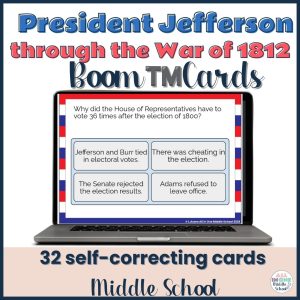
Boom Cards: These can work really well for middle school social studies — especially if you like more structured, self-paced activities. They are interactive and self-correcting. Check out my line of Boom Cards for middle school social studies!
Some Tips
- Get kids into manageable groups. I like to let kids pick a partner, and then I put those partners into groups of 4 kids. Be sure to switch them up often. I like to change for each unit of study.
- It’s fun to have kids name their groups based on the unit of study. Example: A team name for a Native American unit might be “The Confederation”.
- Arrange your groups. Since there are 5 stations, divide kids up accordingly. Then, rotate them around the room. You can figure out how much time you’d like to give them. I would use at least 2 class periods to give kids enough time. So, if you teach a 50-minute block and use two class periods, that is 100 minutes, so that would give kids 20 minutes per station.
- I like to print activities and directions and set my desks in tables during center time. You can put the directions in an acrylic Dollar Store frame or tape it to a file folder so it stands up. Physically moving kids around to different tables helps to keep them more engaged.
- I recommend having kids use some related online game or ongoing project if they finish a center early. There are so many free online games…just search!
- Definitely make time to share. This can be done in many ways. You can discuss, use museum walks, and share bits of their responses…but this is crucial. It validates their work and they will appreciate it.
Your Entire Year of U.S. History…Already Planned
Imagine having your entire year of middle school U.S. History already planned. The All in One Middle School Social Studies Membership includes ready-to-use lessons, engaging activities, assessments, and teacher resources that save you hours of prep time. Whether you’re planning one week or the entire school year, you’ll have everything you need in one place—so you can spend less time planning and more time teaching. Membership is now open, so don’t delay. 👉 Click here to learn more and join!
Questions? Email me anytime: linda@allinonemiddleschool.com
Best of luck to you! Any questions, please comment below.
Linda A. ” All in One Middle School”
Helpful Links
Membership for Social Studies Teachers American History Year-Long Curriculum
Free social studies centers template