When you think of centers, you typically think of little kids, glue, construction paper, and a big mess. As a former first-grade teacher, I can certainly tell you that this is the absolute truth! But centers are NOT just for elementary school. In fact, one of the best literacy center ideas for middle school is for teaching reading skills and strategies. Read here for tips to get started with literacy centers in 4 easy steps.
*I have a free literacy center for you to try…scroll to the end of the article to see!

Why Literacy Centers?
By the time kids get to middle school, the level of skills is completely different from that of elementary-aged students. For the most part, regular education students are decoding with some level of comprehension. However, kids are not able to intuitively and independently apply higher-level strategies such as interpreting symbolism, understanding perspective, and analyzing the theme of the story.
I have seen many teachers address these skills in a “one and done” method. They might tell kids to look for theme and give them a strategy to do so. Then, it is expected that students will be able to do this with any and all future reading assignments. This just doesn’t work.
Teaching vs. Student Learning
Anyone who has been teaching for more than a year will understand that there is a huge difference between what you’ve taught and what students have learned. And our students don’t learn by us mentioning it as direct instruction. Students need to experience learning in a hands-on, minds-on way, with difficult concepts being broken down in a way that relates to their lives.
So how do we get kids to actually learn higher-level reading skills and strategies? It requires some work, but it can be done in 3 easy steps.
Step 1: Decide on the Teaching Skill or Comprehension Strategy
The first step with your literacy center ideas is to decide which skill you are teaching. It is really best to have a plan for the year. Your district might have a scope and sequence for you already. If not, here are some that I recommend in no particular order:
- Symbolism
- Point of View
- Perspective
- Plotline
- Theme
- Dialogue
- Internal Monologue
- Conflict
- Response to Conflict
- Character change
- Character Analysis
- Flat vs. Round Characters
- Minor Characters
You’ll really want to teach this thoroughly, and one at a time. If you need help with planning out your skills and units for the year, read my blog post on planning your units for the year.
Step 2: Teach Your Mini-Lesson
As stated above, there is a huge difference between teaching vs. student learning. However, you still need to do your direct teaching.
A reading workshop model depends on the use of mini-lessons. This is just what it sounds like…short, direct instruction. If you are new to mini-lessons, read my blog post on creating/implementing reading mini-lessons.
For the purposes of the topic of literacy center ideas, here is a brief summary of mini-lesson “best practices”:
- Keep it brief – 10-15 minutes tops
- You do the teaching – kids are listening except for the “turn and talk” portion
- Relate it to their lives – during the “turn and talk” portion, you can bring it to their level
- Be direct – tell kids EXACTLY what you want them to learn
- Keep it engaging – charts, images, video clips are all good ideas
If you need help, I have a bunch of ready-made reading mini-lessons in my TPT store.

Step 3: Brainstorm Literacy Center Ideas
You’ll want a nice variety of centers. They should NOT all be direct instruction and “worksheet” style. However, you might want one that really drives home your teaching objective. Then, create a variety that is a little more fun and engaging. The idea here is to get kids to apply their knowledge, not just merely parrot it back. Here is an example of my literacy center ideas for teaching symbolism:
- Symbolism: This is my more “direct instruction” center that uses a mentor text. I always read the mentor text to the kids at the beginning of a unit. For this center, I am using “The Jacket” by Gary Soto. They have to find possible symbols and what they possibly mean. Most importantly, they then list objects from their lives and what they could possibly symbolize (i.e. their bike could symbolize freedom).
- Common Symbols: Here, I give them a list of common objects and what they might symbolize. Then, kids write where they have or could see this symbol. For example, I give them “red” and “power” as possible symbolism. They might write that they have seen it in The Wizard of Oz on the ruby red slippers.
- Craft: Kids still love to make things. I have them make an “agamograph”, which is where you see 2 different things based on the angle that you view them. I have kids draw an object and a word. Here is an example:

- Songs: I work in music that kids actually know and hopefully like for as many centers as possible. In this one, they listen to a bunch of songs (i.e. “Believer” by Imagine Dragons) and write objects and what they possibly symbolize.
- Flip Book: Kids love making these! This flip book includes a bunch of activities about symbolism. This is actually a free item (listed below as well). Grab your free symbolism literacy center!
If you are interested in my symbolism literacy centers, they are available for purchase on my TPT store.
Step 4: Create Literacy Center Ideas that Relate to Students
This is a bit of a repeat of step 3, but it bears repeating. Kids need activities that they can relate to, not just worksheets on a topic. You’ll need to do some thinking on this, but if you look at my examples above, hopefully that will spark ideas. Having kids create a craft of an object that is symbolic in their lives, for example, goes a lot further than a worksheet on a short reading passage that includes a symbol.
Running Your Centers
When kids do their centers, I split them up into groups. I always print centers as I feel like it’s more “tangible” that way. I set desks into tables (I usually have groups of 4, so I create tables using 4 desks). I put all materials on the table, including directions, crayons, glue sticks, etc. Then I rotate students through. I usually give them about 20 minutes. My centers usually last about 2-3 days.
Need More Help with Literacy Center Ideas?
You are in luck…I have a free product for you to try. It’s a symbolism flipbook. It’s one of my favorite freebies…be sure to grab it!

I have a whole series of ready-made literacy centers available in my TPT store. Each set:
- Comes with 5 different activities
- Teaches one higher-level reading strategy/skill
- Enables students to understand the skill in a personal way
- Is fun and engaging
- Is perfect for your teacher performance assessment – the learning is student-centered and active
Interested? Check here for more information:
 This bundle contains 7 sets of literacy centers, but each is available separately as well.
Autopsies/Games
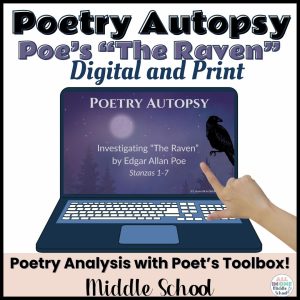
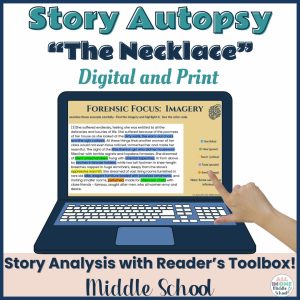
Sometimes, it’s nice to switch things up a bit. Try using a poetry autopsy, a story autopsy, or an escape room. Here are some ready-made ideas to get you started: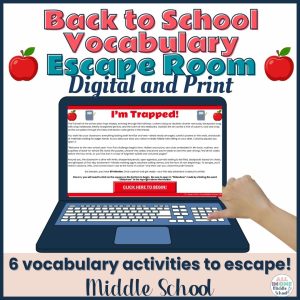
Not enough time to read? Try the Podcast!
I recently started a Podcast for middle school language arts teachers. Check it out!

If you have any questions or comments, please feel free to comment below.
Wishing you and your students all the best.
-Linda A. “All in One Middle School“
Helpful Links
Free Symbolism Flipbook Literacy Center
Join the All in One Middle School Membership!
Literacy Centers Available in my TPT Store
Reading Mini-Lessons Available in my TPT Store
One-on-One Coaching for Observations and Lessons
Teaching Writing Workshop Course
Click here to join the Middle School Language Arts Facebook Group