Grammar lessons are the best! Just kidding. If you are a language arts teacher, I’m sure you already feel like abandoning this blog post. We know kids need it, yet somehow we are all over the place in this country with how we should teach it, when we should teach it, and how much we should teach it.
Do You Even Have a Grammar Program?
As the title suggests, I’m helping you to “sneak in” some grammar lessons, and I am hoping that you have some sort of program (even though I know many of you do not). As an FYI, I have used NoRedInk and IXL, and I like them both for different reasons. This article is more about getting in grammar a bit more easily and naturally.
Begin rant: It’s mind-boggling to me when I hear about teachers scrambling to figure out how they are going to teach grammar and what grammar lessons and activities to use. Some teachers have no resources to effectively teach grammar lessons. Why haven’t the schools done this? If the school curriculum powers that be have done their job, teachers would not be in the position they are in to figure it out for themselves, and there would be some kind of consistency across the country regarding such a standard piece of language arts education. OK, rant over. (Maybe.)
In a perfect world, we would all have the time to naturally teach grammar and have engaging tools at the ready. This is not a perfect world. But I do have some suggestions to hopefully make it a bit easier.
For me, I found that creating my own program was helpful because it is less time-consuming, more hands-on, more engaging, and less tedious for kids (and me). It is available in my TPT store, so check it out if you need a program. I also have a free sampler if you’d like to check that out to see if it’s right for you.


Why Teach Grammar Lessons in Middle School
As a blogger, I always feel like it’s necessary to go into the “why”. Is it really necessary here? OK, I’ll play along…but I’ll keep it brief. Here are a few reasons:
- We are language arts teachers. Grammar is part of language arts.
- Having good grammar is a must in any academic paper.
- Having good grammar is a must in any speaking situation.
- Kids don’t naturally understand all the components of grammar. It needs to be taught directly.
- When you teach something directly, kids don’t always apply it, so they need practice.
To sum it up, we must teach grammar. Period. You know it, I know it, and society knows it. So, let’s do this!
Tip #1: Make Grammar Lessons Personal
In any teaching situation, the best way to get a concept to stick is to make it personal. I have also been a social studies teacher, and I know how important it is to make topics relatable. Kids don’t understand, for example, taxes, until you tax them (as an activity, of course…I would never tax a student…or would I…lol).
The same holds true for grammar lessons. It’s a bit trickier, but it can be done. I absolutely LOVE the “Questions” feature on my Google Classroom™, and I use it all the time for my anticipatory sets (AKA “bell ringers” or “do now”). Here are some suggestions:
- On a Monday morning, ask kids to describe their weekend using a noun, an adjective, and a verb.
- Ask kids to write a compound sentence that describes their favorite Netflix series.
- Ask kids to write a sentence about their BFF using an objective pronoun.
The possibilities are endless. And honestly, they love doing this!
For more info on the “Questions” feature, read here: “Three Easy Ways to Use Questions in Google Classroom™“
How My Grammar Lessons Are Personal
Take a look at an example grammar lesson and activity from my year-long program. You will see how the grammar lessons are brief and the activities are engaging. Hopefully, even if you don’t choose my program, you will get the gist of making your grammar lessons brief and more personal:
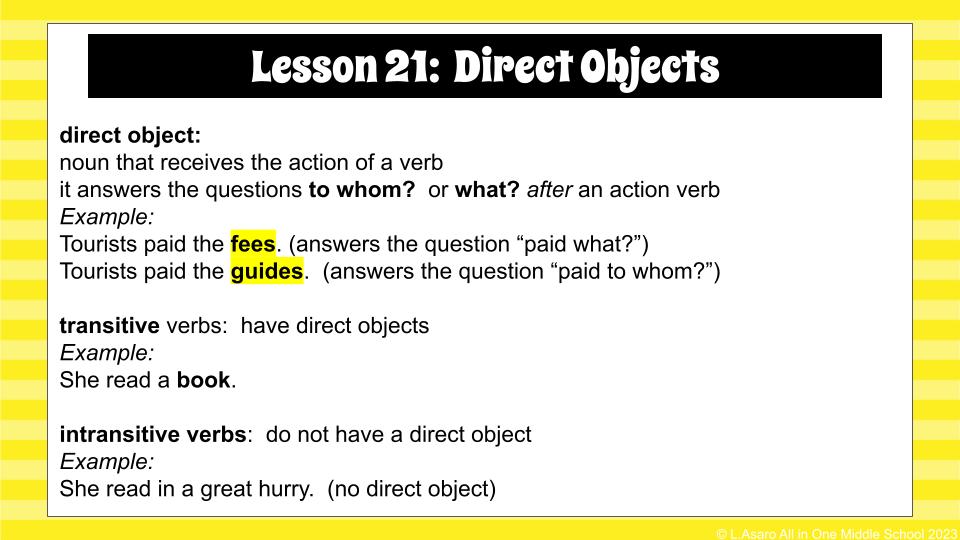

Tip #2: Make Grammar Lessons Engaging
Many of us remember the mind-numbing boredom of grammar classes and homework. It’s not necessary to overdue grammar, either, especially in isolation. Finding quick and engaging ways is easier than ever with the dawn of so many online platforms.
There are many online resources to use, some paid and some for free. I do like online tools at times because it is just much more engaging than paper and pencil grammar lessons and activities.
If you are looking for something free, I would recommend NoRedInk. It’s engaging and they personalize the prompts to kids’ interests (they complete a survey when signing up). I usually do a QUICK grammar lesson on Mondays and briefly go over the assignment (this is about a 5-minute lesson…no need to kill it!). Then, I assign a lesson on NoRedInk or IXL, and students have until the following Monday to turn it in.
Engagement – Take it Up a Notch
Want to get them really engaged? MUSIC is the answer! I incorporate music any time possible in language arts. Having the latest hit or funny song playing as kids come in gets them revved up. As a “do now”, I might have them pick out some of the verbs or correct the verb tenses (I’ll bet you didn’t know that so many songs have messed up verb tenses!).
There are many resources on TPT and Boom™ as well. There’s a choice board and various activities that are really engaging. Aside from my full-year program, here are some of my favorite grammar lessons and activities:
- Grammar Choice Board – You will love this one! 15 reusable, creative grammar activities – can be used the entire year
- Fall and Winter Holidays Language Arts Boom™ Cards – self-grading
- Mardi Gras Parts of Speech Boom™ Cards – self-grading
- Halloween Pixel Art Parts of Speech – self-grading
- FREE! Back to School Parts of Speech Pixel Art (can really be used any time of year; self-grading)
Tip #3: Make Teaching Grammar in Middle School a Priority
Finally, we all know that if you want something done in class, you have to plan for it and make it a priority. This means being consistent as well. Start by selecting your grammar goals for the month…one per week is sufficient. Here is a plan that I follow on most weeks:
- Monday: Introduce the concept and assign NoRedInk or IXL, or use a lesson from my full-year program.
- Tuesday: Use a “question” on Google Classroom™ that is related to the skill.
- Wednesday: Incorporate the skill into your reading or writing mini-lesson. For example, if the lesson is on subjective/objective/possessive pronouns, you can point out a few in their reading or have them share one from their writing. Make it quick and natural.
- Thursday: As an exit ticket; incorporate your skill. As an example, if you are in the middle of a class novel, have kids write a complex sentence to describe the character.
- Friday: At the end of class, give kids a little time to work on finishing Monday’s assignment.
In this manner, you will get a lot of grammar lessons and activities without using up a huge chunk of time from an already busy schedule.

Additional FREE Help
I just started a grammar series on my YouTube channel! The lessons are free. Be sure to check them out.

Not enough time to read? Try the Podcast!
I recently started a Podcast for middle school language arts teachers. Check it out!

If you have questions or comments, I’d love to hear from you. I would especially love to know if you have a district-wide grammar program. Drop your thoughts in the comments below!
Wishing you and your students all the best, and don’t forget to grab your freebies (check them out below).
-Linda A. “All in One Middle School“
Helpful Links:
Join the All in One Middle School Membership!
FREE Back to School Parts of Speech Pixel Art
One-on-One Coaching for Observations and Lessons
Teaching Writing Workshop Course
Click here to join the Middle School Language Arts Facebook Group