ELA teachers: Help is here for curriculum mapping! If you are struggling with how to plan your year or just need some fresh ideas, then you are in the right place. Join me for a 10-month series on ELA curriculum mapping for your middle school classes. This month, we will focus on independent reading and on your third unit, which is a literary analysis essay. If you haven’t read the blog post for month 1 and month 2 yet, you might want to go back and do that first.

Independent Reading: A Crucial Part of Your Curriculum Mapping
I would be hard-pressed to find something that I personally believe is a more important role as an ELA teacher than instilling a system (and love) for independent reading. Let’s take a look at what to consider.
Expectations/Goals
The first thing to consider when incorporating independent reading as part of your curriculum mapping are your expectations and goals. Consider:
- How much do you want kids to read each week? I find it difficult to really pinpoint this. I used to have independent reading time as “20 minutes a night” as part of my daily homework but after a while, it became “white noise”. Instead, I focused on an authentic love of reading, showcasing novels they would be interested in during class (see below), and providing class time for independent reading.
- Will it be ongoing? Because I taught alternate units (meaning one month would be reading, and then we’d head into a related writing unit), I had to decide if I would “require” kids to read during my writing units. Again, as I said above, I ultimately opted for more “authentic” reading time instead of “requiring” it. I wanted kids to be really, really eager to read…not just reading because I told them to do it. This requires a genuine commitment to their reading lives with a system that will promote it. Read below for more info.
A System
Next, you’ll want to have a solid system in place when incorporating independent reading into your curriculum mapping. Some items to consider:
- Will you have kids reading in class? – I say yes, yes, and HECK YES. When I’m in a reading unit, reading during class is built in. At other times, there are different ways to handle it. You could have the last 10 minutes of class as reading time. You could use half the period each Friday as reading time (followed by First Chapter Friday, which I’ll talk about below). Whatever it is, be sure to give kids time. If you don’t, the message is that you don’t value it, and I know that can’t be the case.
- Will you want something documented as proof of their reading? When I first started teaching middle school ELA, I was obsessed with their reading logs. They became the bane of my existence. I have since forgone such elaborate ideas because I want them to be more authentic readers. Authentic readers read books, talk about books, and get ideas for their next reads from others who share their interests. So I built in time for this. I did a First Chapter Friday, which showcased lots of books from my shelves (and some that were not on my shelves). As far as “keeping track”, I did use an interactive reading bulletin board where kids could record what they were reading. I wasn’t a stickler about this; in other words, there were no stiff requirements. I did find that kids naturally loved adding to it. Take a look at my Interactive Reading Bulletin Board, available on TPT.
- How will you showcase new books? For me, First Chapter Friday was the answer. My Fridays were usually a quick vocabulary lesson first, then First Chapter Friday, and then independent reading time. We’d have an open dialogue after First Chapter Friday about anything they were currently reading. I found this to be the most authentic way to get kids interested in books that they’d otherwise not even know about. I have a YouTube channel with First Chapter Friday reads! I know reading to kids aloud is important, but it can be tiring and sometimes tedious if you are teaching 6 or 7 classes. I always include different genres and different books to highlight different times of the year.


In short, independent reading is a crucial part of your curriculum mapping, so you’ll want to give it plenty of thought.
The Main Event for Month 3 Curriculum Mapping: The Literary Essay
Ahh, the literary essay…it’s something we love to hate and hate to love when using it as part of our curriculum mapping. My guess is that you are required to teach a unit like this, and as we all know, teaching kids how to write a good, solid essay is something that will benefit them greatly throughout their academic careers.
Although it’s definitely a challenge, I’ve come up with a plan for you. If you’re looking for an easy fix because time is of the essence and curriculum mapping is complex, be sure to check out my complete, month-long unit on the literary essay in my TPT store.
Be sure to also check out my FREE essay writing pieces for your bulletin board. Your kids will use this throughout the essay writing process:

Step 1: “Essay Boot Camp”
The first step when doing my essay curriculum mapping was to do a lesson on what I called my “Essay Boot Camp”. This is basically a quick overview of essay writing because kids have usually been exposed to this style of writing. As we know, however, we really need to teach it explicitly and let kids know what we are expecting from them as there are variations on literary essays.
I taught this as a mini-lesson, which means that it was quick and direct. At the end, they worked on a “Finish the Essay” assignment, which was used as a pre-assessment. Continue reading step 2 for more details.
Step 2: Pre-assessment
This term used to make me crazy because I always felt that the administration put too much emphasis on it but never really cared about the results. It always seemed like some detached, extra activity that was of little to no value in my actual teaching. I’ve made my peace with the pre-assessment once I found a way to make it into a viable activity.
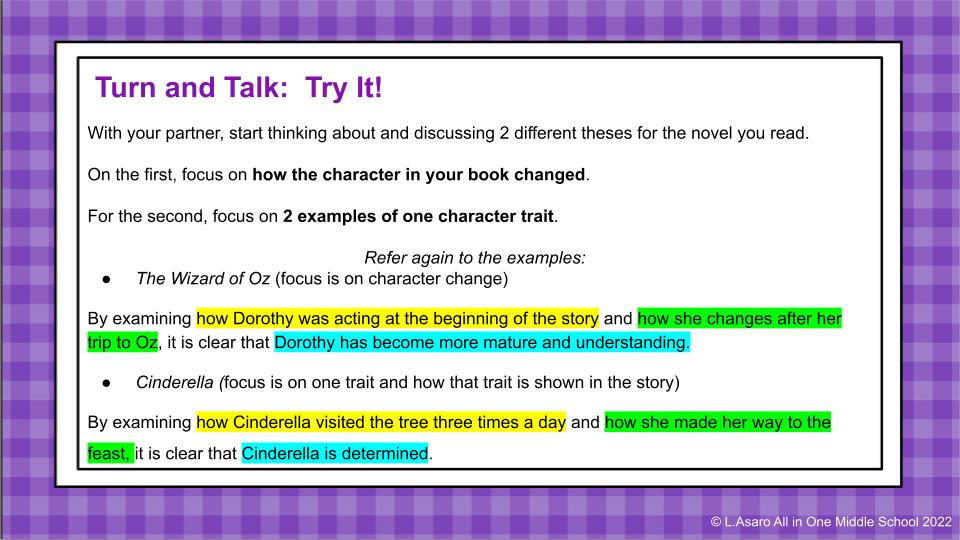
What I do is have kids do a “finish the essay” for the first part of the unit. You basically give them the first two paragraphs and have them finish it before giving any formal instruction. It should be somewhat easier for them to write because the intro paragraph that you give them lays out the reasons in the thesis.
I score these in a very general manner, using a checklist of what I want to focus on for the unit. For example, I might include a list such as topic sentences, giving text evidence, proper citation, and a strong conclusion. Then I usually use this score as a range and group kids into 4 levels of instruction. This was used not only for my own instruction, but I used it for my state goal-setting paperwork (we called it “Student Growth Objective” AKA “SGO”…not sure if it’s the same in every state). Plus, it’s something I kept printed on a clipboard and used it (especially during teacher observations…admin really, really loved this).
Finally, I had them score their own (even though I scored them…but that score was not a “real grade” as it was only for pre-assessment purposes). I’d have kids then highlight what they needed to work on using the same checklist that I used for scoring. This way, we start the unit with an understanding of where they are and where they need to be. I set my checklist for this up in a way that had two columns; one for “before” and one for “after” (see more on this below under the heading of “Self-Reflection”). Doing this set the groundwork for this part of my curriculum mapping.
Step 3: Mentor Essay
I’d give kids a completed essay that I wrote myself, and it was the same one that I used for the preassessment. This way, we have something to refer to when teaching the essay.
Step 4: Mini-Lessons
Decide on how you would like to instruct. I went paragraph by paragraph with my lessons, adding a separate lesson for the thesis, text evidence, and proper citations.
With mini-lessons, it’s important to keep them quick and streamlined. The purpose of writing workshop is to get kids to write, not just to listen about writing. Include direct instruction with clear examples, using your mentor essay to help. If you need more help with this, read my blog post “Creating Effective Mini-Lessons for Writing Workshop”.

Step 5: Revision: Essay Writing Centers
At the end of a writing piece, having some sort of center activities will greatly help kids examine their writing and make improvements. The key is to make them interactive and engaging. Here are some ideas of items that should be checked over and would make great centers:
- Thesis
- Text evidence
- Proper citations
- Topic sentences
- Concluding statements
- Vocabulary improvements
- Sentence structure variations

If you need help with this, check out my essay centers, available in my TPT store.

Step 6: Self-Reflection
Have kids go back to their preassessment essay. Have them look over what they highlighted as an area of need and see if they think they have improved. I usually set this list up as “pre” and “post” so they can easily check off and write some notes on how they think their learning progressed. This is called “metacognition”, which is basically understanding your own knowledge-based and is very, very helpful in moving students forward in their learning.
Teaching the Literary Essay: You’ve Got This!
Although it’s not easy to set up an entire unit, it can be done with some work and focus. If curriculum mapping feels overwhelming, remember that you can always grab my ready-made unit and essay centers to help you along.

month 3 of your curriculum mapping.
Let’s Make This Simple: Grab Your Month-Long Curriculum!
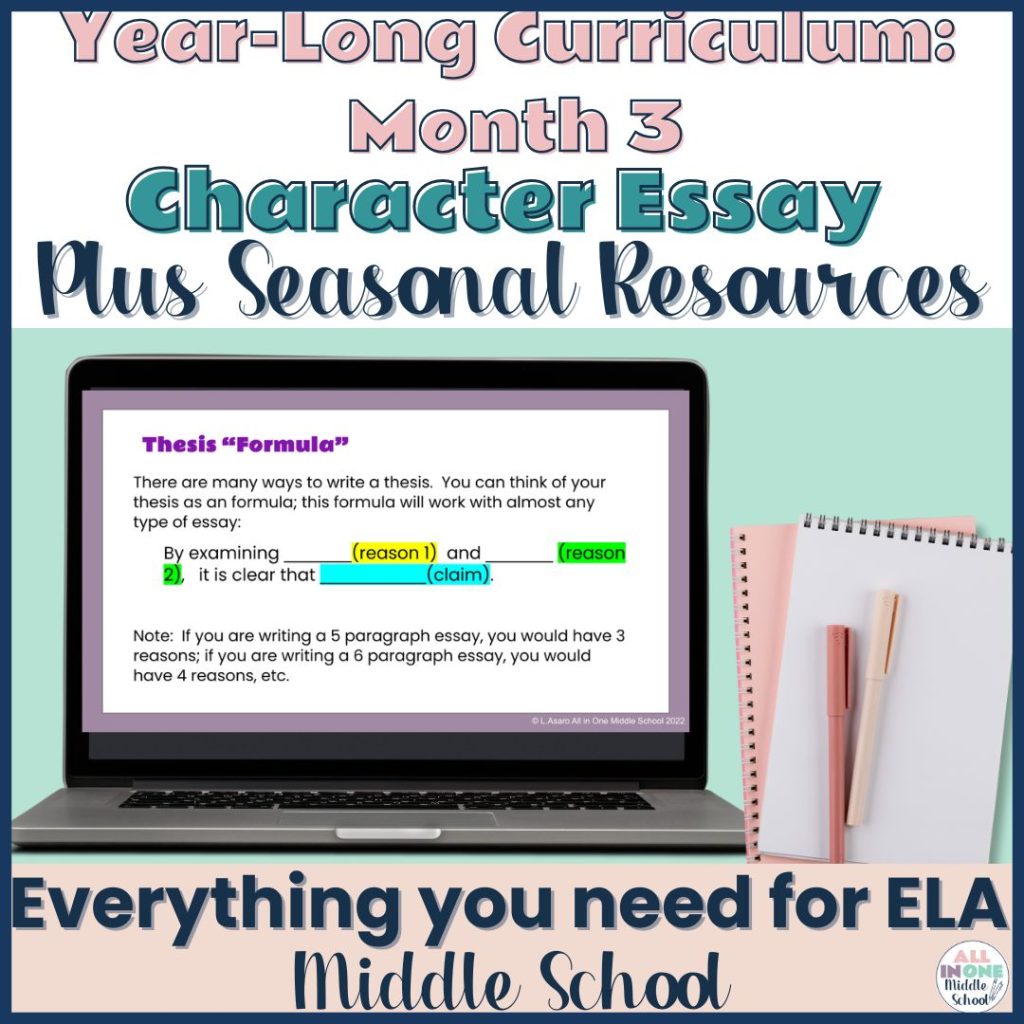
Grab this month-long curriculum bundle resource and you’ll get absolutely EVERYTHING you need for the third month of school. This month focuses on writing a literary essay. There are full, editable lesson plans for each day of the unit. There are also 6 other resources to supplement your teaching, which add a seasonal flair to your teaching and classroom. Everything is well-organized within a table of contents and is fully linked, so it’s easy for you to access all of your materials each day.
Developing curriculum mapping for ELA is daunting. So if you are interested, I’ve developed a membership for ELA teachers. This has been highly requested. It’s something I’ve been wanting to do because I know how ill-prepared many new teachers are after college. This has nothing to do with the teachers and everything to do with teachers’ colleges and the lack of good onboarding in districts in our country.

It’s a very robust membership. Some of the highlights:
- Complete curriculum mapping with access to 9 full-month units for the year
- Access to literacy centers, mini-lessons, a full-year grammar program, choice boards, video lessons, and seasonal activities
- Access to a private Facebook group, where I can answer your questions and go live to help you with more complex units
Click here for more information. As of now, we are in the “founding members” stage. You can lock into the price for as long as you keep up your membership. I’d love to have you!
Any questions or comments? I’d love to hear what you do for month three in your ELA curriculum. I can also help if you have specific questions. Drop a comment below!
Wishing you all the best in planning your ELA curriculum map!
-Linda A. “All in One Middle School“
Helpful Links:
- Join the Membership
- Interactive Reading Bulletin Board
- Literary Analysis Essay: Month-Long Unit
- Essay Writing Centers
- Essay Video Lessons
- Free Essay Writing Bulletin Board
- My YouTube Channel – FREE lessons where I teach your class, plus First Chapter Fridays!
- Free First Chapter Friday Recording Sheet
- One-on-One Coaching for Observations and Lessons
- Teaching Writing Workshop Course
- Click here to join the Middle School Language Arts Facebook Group