This is the eighth and final blog post in a mini-series on starting reading workshop in middle school. This post will look at reading assessment examples in middle school reading workshop.
If you are implementing reading workshop in your middle school classroom, you might be cruising along with your mini-lessons, book clubs, and discussions. And then…you have to come up with a grade. Where do you start? Let’s take a look at some different reading assessment examples for your middle school reading workshop.

1. Grading Reading Notebooks as Assessments
One of the reading assessment examples is the reading notebook. If you are doing reading workshop, you will want your students to work in a reader’s notebook. I did a whole blog post on reading notebooks, so be sure to check it out if you need help with this.
Basically, a reading notebook is a place for students to house notes and to complete entries on their reading. It can be digital or an actual notebook. I use a combination of both. I have a freebie that has a bunch of reading notebooks notes and activities to get you started. Click here for your free reading notebook notes and activities.

So, do you grade the notebook? I say yes. It is difficult to motivate middle school-age students if they don’t think that “it counts”. With that said, I would develop a very loose system. With a printable notebook, I like to go around and give kids a score of 1-5 on their assignments as I am conferencing. For that score, my students know that they need to complete the activity on time, follow any and all directions, put in effort, and have minimal “mechanical” errors. I either count them as a homework grade or loosely average these assignments out at the end of the unit for a grade.
Other Reading Notebook Options
You can do something very similar with a digital notebook as one of your reading assessment examples. As you are conferencing, you can open the student’s work at the same time you are talking. Put in any comments as well as a quick grade. This way, you avoid burdening yourself with grading all of this at home. What kids write is meant more for a discussion point, not as a formal assignment.

I would not be a stickler for every little bit of mechanics, but I also would not ignore careless errors such as capitalization and punctuation. Whatever it is, decide on a simple rubric or checklist before the unit begins so that students know exactly what is expected of them. Give them examples of high-quality work so they know what you are expecting.
My notebooks usually count in a “lower” category for their overall grade, such as a homework or project grade (as opposed to a test or final piece). This way, students are accountable, but they have the freedom to try without having to worry about every little mistake.
2. Grading Group Discussions
A key component of reading workshop is to have kids in book clubs or partnerships. Even if you can’t get kids in clubs reading the same book, you can put kids into groups to discuss. For example, if you are doing a historical fiction unit, it is great to put kids into book clubs. Ideally, they will read the same book, but if not, they can still go into groups or partnerships to discuss. If you have not read my blog on book clubs, click here to read it. There are lots of tips in there.
When students are discussing (and you want to have planned discussion questions), you have to keep an eye on them. So do you grade a discussion as part of assessments in middle school reading workshop? I say sometimes yes, and sometimes no. I tell my kids that some discussions are graded and that I will be walking around to see if they are on target.
Examples of Grading Group Discussions
If I am grading that discussion, I have kids fill in some basics from their group. I actually do this on a Jamboard so that they can all contribute, but you can also do this on a shared Google doc or on a piece of paper. Do NOT have them write everything. Rather, a few key points would be best.
Example: Let’s say that the discussion question is “What is a possible symbol for the seashell in Number the Stars?”. They could briefly jot some ideas, maybe one or two. The idea is to just hold them accountable with the least amount of writing for them (and for you to grade). Again, I would keep this grade in a lower category.
3. Hexagonal Thinking
This is my absolute favorite of all of the reading assessment examples. The concept is this: kids write aspects of their reading on hexagons and look for connections, then annotate them. If you’ve never tried it, I HIGHLY recommend it. Here’s why:
➡️Hexagonal thinking is a hands-on way to demonstrate knowledge of higher-level thinking and comprehension
➡️It’s a great way to get kids to work cooperatively and to initiate discussions
➡️It’s an excellent and deeper-level assessment piece without the boredom
➡️Hexagonal thinking is a sure-fire way to ace a teacher observation because it is completely student-based learning
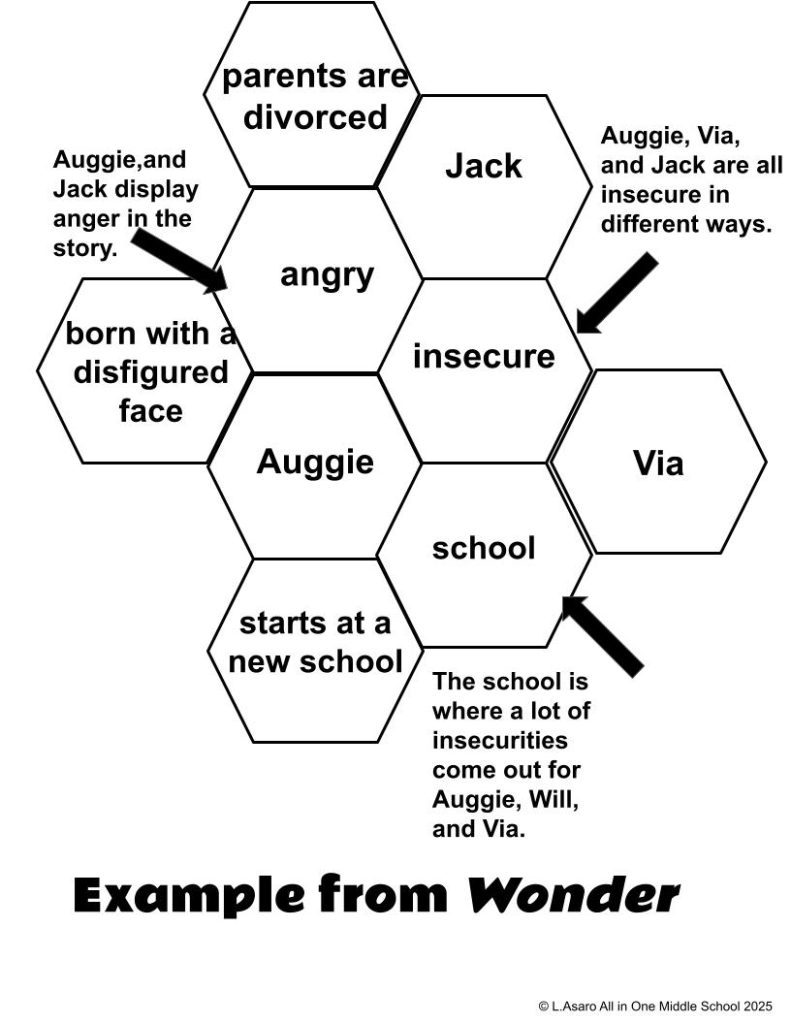
If you’re looking for a ready-made hexagonal activity, check out my Hexagonal Thinking for Any Novel in my TPT store:

4. Final Assessments in Middle School Reading Workshop
There are many different ways to assess kids at the end of a reading unit. I do like to mix it up a bit. What you choose will depend on your district’s philosophy and your goals for your students. Here are my “go-tos” for final assessments:
Cold Reading Assessment Examples
When I do a reading unit, one of my reading assessment examples is to do a “cold read” test. This means I will give my students a short story or article from the same genre to read on the day of the test. Then there are questions about this short story that is new to them.
For example, in my historical fiction unit, I do a cold read of “The Little Ships” (author Louise Borden) about the rescue at Dunkirk. A cold read means that this is a new story to them. It is not the mentor text that we used, but rather a story that they haven’t read, at least in my class. On the day of the test, the kids would read the story and answer questions about the story based on the skills I taught.
For example, in my historical fiction unit, some of the skills that I teach are the importance of setting, symbolism, minor characters, and theme. So, I will have questions related to those skills for the short story of “The Little Ships”.
Other Considerations for Cold Reads
I do provide a study guide for my students. My study guides are usually interactive, which means that the students need to do the work. So I might give them a sheet that has a list of terms, such as setting, symbolism, and theme, and they would fill in the notes. This way, they are prepared with what they need to know so that they can apply it to this “cold read”.
Please note that this can be modified. I have special ed students who get to do this test as a “warm read”. They get the story a couple of days in advance so that they have time to process. And, during the pandemic, everyone got a “warm read” because it was just too stressful and I needed to modify. Whichever way you do it, this is a great way to see if kids are applying skills to a new piece of reading.
Writing Pieces as Assessments in Middle School Reading Workshop
Another way to do final assessments in middle school reading workshop is by having students do some sort of writing piece about their novel. As an FYI, I would usually save a formal essay for my writing unit. For example, the writing unit that follows a historical fiction reading unit is a literary essay on theme. So, I do not typically do this type of writing as an assessment. This type of writing is a skill unto itself and it might give more insight into writing than it does to reading. Thus, it is not the best assessment of a student’s reading ability.
I do less formal pieces if I am assessing reading. For example, I might have them create a slideshow about the plotline. This way, the writing part is minimal and they can use visuals as well. I have also had them create a plot of a sequel to the novel on a slideshow. They enjoy this less-formal format.
Another less formal way to do a writing piece is having kids write out an important scene from the book. They write it in a way that you would write for a play. We then present in class, and I grade them as I listen.
You can get creative here with what you assign as a writing piece. Just make sure that it is not too formal because then it becomes an assessment of writing rather than of reading.
Choice Boards
A really fun way to assess kids is by doing a choice board with some related activities. In my assessment for our social issues unit (which is a unit on fiction where characters are faced with a social issue, such as homelessness, discrimination, etc.) I give kids a choice board.
There are usually about five selections. Some ideas are creating a playlist for the main character, creating a visual scene of the main setting, having the character write a letter to someone of significance, etc.
I would caution you, though, to be very specific with what you want students to accomplish in each of these activities. For example, if you go with the playlist idea, you can’t just write “Create a playlist”.
Here is a sample of what I include as directions for a playlist
- Be specific about the number of songs. 3-5 is a good number.
- Give a link to the song (make sure it’s “clean).
- Write down the artist.
- Explain why you chose each song in 3-5 sentences.
- Pick one line from each song that really speaks to the character and explain why in 1-2 sentences.
When you are specific like this, you’ve created a rubric checklist that will help the students know what they need to do. You can also assign point values, and you can use this to easily grade.
Assessments in Middle School Reading Workshop: You’ve Got This!
I hope these reading assessment examples and suggestions were helpful. Just remember to keep it simple if you are just starting. Having great mini-lessons, book discussions, and conferences is the most important part of your workshop. As time goes on, you will naturally develop a good groove with your assessments in middle school reading workshop.
Not enough time to read? Try the Podcast!
I recently started a Podcast for middle school language arts teachers. Check it out!

If you have any questions or comments about reading assessment examples, please feel free to comment below.
Wishing you and your students all the best.
-Linda A. “All in One Middle School“
Helpful Links
Join the All in One Middle School Membership!
Free Reader’s Notebook Activities
Hexagonal Thinking for Any Novel
Reading Workshop products available on TPT
Subscribe to my weekly email for tips, future freebies, and the latest product release
Join our Middle School Language Arts Facebook Group